What are the most common 401(k) rollover mistakes?
The top 401(k) rollover errors are: choosing an indirect rollover, sending money to an ineligible account, missing the 60-day deadline, mixing pre-tax and Roth money, overlooking after-tax basis, rolling over employer stock without NUA analysis, ignoring vesting rules, attempting pre-separation rollovers when the plan forbids them, rolling during a high-income year, forgetting one-per-12-month IRA rollover limits, failing to invest the IRA, and neglecting expat-specific tax and residency rules. Each has a simple fix covered below.
Last updated: 25 January 2026
Why expats roll over a 401(k)
A rollover moves your old employer’s 401(k) into an account with broader investment choice, clearer control and, often, cleaner tax planning. Most people move to:
- Traditional IRA – tax-deferred to tax-deferred when you roll pre-tax 401(k) money.
- Roth IRA – after-tax to after-tax when you roll Roth 401(k) money. Rolling pre-tax 401(k) to Roth is a conversion and is taxable in the year of transfer.
- Less commonly: a new employer’s plan, if it accepts roll-ins.
For expats, the decision also interacts with residence, treaty treatment, and your broader estate and investment strategy. Consolidation and active oversight are recurring benefits in cross-border planning.
12 frequent 401(k) rollover mistakes
1) Choosing an indirect rollover instead of a direct transfer
If the plan cuts a cheque to you, it must withhold 20% for tax. You have 60 days to deposit the full amount into an IRA, topping up the withheld portion from cash. Miss that and the shortfall is taxed and potentially penalised if you are under 59½.
Avoid it: ask for a trustee-to-trustee transfer to skip withholding.
2) Sending funds to an ineligible or mismatched account
Roth 401(k) to Traditional IRA isn’t allowed. Pre-tax 401(k) to Roth IRA is allowed but taxable.
Avoid it: match like-for-like tax treatment unless you intentionally plan a Roth conversion.
3) Missing the 60-day deadline on an indirect rollover
Late means taxable, and possibly a 10% early-withdrawal penalty. Self-certification relief exists but is narrowly defined.
Avoid it: use a direct rollover. If you must go indirect, calendar the 60-day clock the day funds arrive.
4) Mixing pre-tax, Roth and after-tax contributions
Many 401(k)s contain multiple “sources” of money. Sloppy instructions can send the wrong dollars to the wrong destination.
Avoid it: instruct your plan to send Roth 401(k) to a Roth IRA, pre-tax to a Traditional IRA, and handle after-tax (non-Roth) basis deliberately (see mistake 5).
5) Mishandling after-tax (non-Roth) basis
You can often send after-tax basis to a Roth IRA tax-free while sending associated earnings to a Traditional IRA.
Avoid it: ask the plan for a money-source breakdown and execute a “split” rollover.
6) Ignoring Net Unrealised Appreciation (NUA) on employer stock
If your 401(k) holds company shares, a specialised NUA route may reduce lifetime tax by treating the stock’s growth as long-term capital gain instead of ordinary income.
Avoid it: get specific advice before liquidating employer stock inside the 401(k).
7) Overlooking vesting and plan-rule constraints
Employer contributions vest on ERISA schedules, and some plans don’t allow in-service rollovers until age 59½ or at all.
Avoid it: read the plan document, confirm vesting, and check in-service distribution rules before you start.
8) Rolling in the wrong tax year
Converting a large pre-tax balance in a high-income year can push you into higher brackets and phase-outs.
Avoid it: target lower-income years, early retirement windows, or years with significant deductions. See the timing table below.
9) Forgetting the one-per-12-month IRA-to-IRA indirect rollover limit
This limit does not apply to direct transfers or 401(k)-to-IRA rollovers, but it bites if you later move IRA-to-IRA by cheque.
Avoid it: use custodial transfers, not 60-day cheques, for IRA-to-IRA moves.
10) Leaving the rollover cash idle
Many providers park incoming rollovers in a settlement or money market fund. Long delays mean missed market participation.
Avoid it: pre-decide an asset allocation and place trades immediately after funds arrive. Consolidation helps oversight and rebalancing.
11) Neglecting cross-border residency and treaty issues
Your host country may not treat an IRA the way the US does. Even tax-free US moves can have foreign-tax consequences. Double-tax treaties vary, as do reporting and time-apportionment concepts elsewhere in your plan. Thoughtful structuring reduces friction.
12) Choosing accounts or platforms that won’t serve non-US residents
Some US custodians restrict new IRA openings or service for clients with overseas addresses.
Avoid it: confirm onboarding and ongoing service while abroad before you begin.
Allowed vs restricted rollover paths
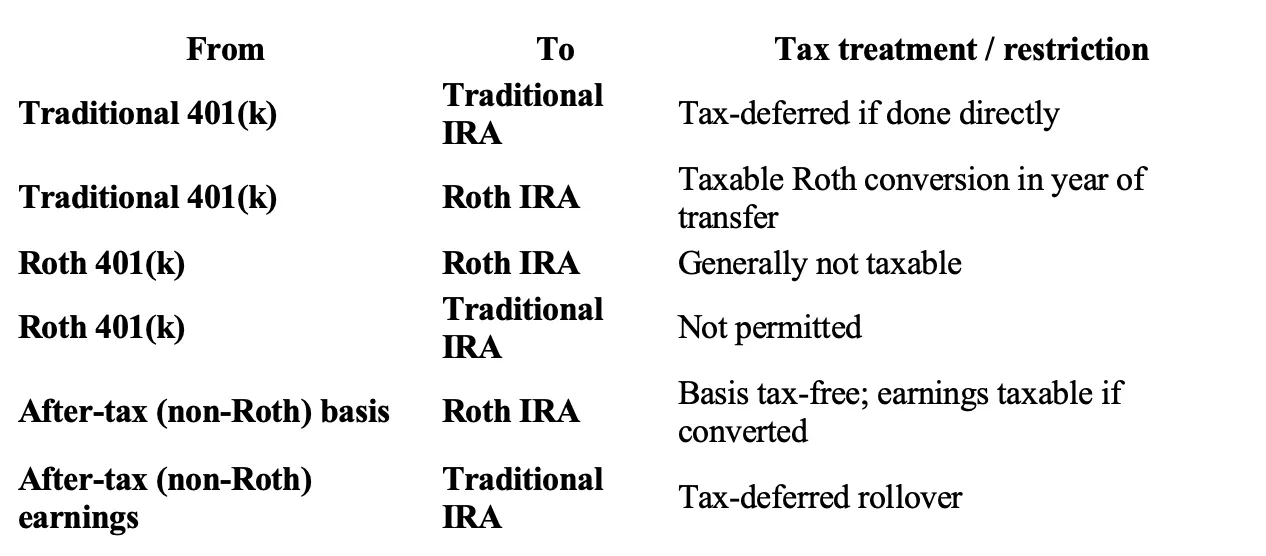
Tip: instruct the recordkeeper in writing for a split rollover when after-tax money is present.
Timing matters: when to consider a rollover or conversion
After retiring or during a sabbatical
Lower income may reduce conversion tax.
Early in the calendar year
More time to reserve for the tax bill; conversion in Jan 2025 is payable by April 2026.
Late in the calendar year
The Roth “five-year clock” starts on 1 January of the conversion year, so a December conversion nearly counts as a full year.
Important: RMDs begin at 73 for most tax-deferred accounts (transitioning to 75 for those reaching age 74 after 31 December 2032). You cannot roll over the RMD amount; take it first, then roll the remainder. Roth 401(k)s no longer require RMDs during the owner’s lifetime from 2024.
Extra layers for internationally mobile individuals
Residency and tax-year mismatches
The US taxes by calendar year and values distributions in USD on the distribution date. Your host country may use different tax years and currency rules, creating FX and timing mismatches. Keep records of dates, amounts and USD/FX rates. Cross-refer your UK Statutory Residence Test position if the UK is in the mix.
Double-tax treaties and reporting
Many countries do not give IRAs the same treatment as US law. Some allow tax deferral; others do not. Where relevant, double-tax treaties determine taxing rights on pensions and investment income. In Europe, pension withdrawals and the treatment of wrappers vary by country; plan ahead before you move or draw benefits.
Platform selection and future moves
Choose custodians familiar with expat clients, multi-currency dealing and cross-border anti-money-laundering standards. If you also hold UK or offshore assets, ensure the portfolio you build inside the IRA coordinates with other wrappers and vehicles used in expat planning, such as international bonds or trusts, to avoid duplication and inefficiency.
How to avoid 401(k) rollover mistakes: a practical checklist
Before you start
- Obtain your plan’s money-source breakdown: pre-tax, Roth, after-tax basis, employer stock.
- Confirm vesting status and in-service distribution rules.
- Verify your chosen IRA provider can open and service accounts for non-US residents.
Set the destinations
- Open a Traditional IRA for pre-tax dollars.
- Open a Roth IRA for Roth dollars and, where appropriate, after-tax basis.
- Decide whether a Roth conversion fits your tax plan this year.
Execute cleanly
- Request a direct, trustee-to-trustee transfer.
- For after-tax money, give split rollover instructions in writing.
- If employer stock is present, evaluate an NUA strategy before moving the shares.
Mind the clocks and limits
- Avoid the 60-day pitfalls; never rely on postal timelines.
- Remember the one-per-12-month limit applies to indirect IRA-to-IRA rollovers only.
Invest promptly and monitor
- Pre-set your asset allocation and place trades as soon as funds settle.
- Consolidate old plans where appropriate to simplify rebalancing and reduce overlapping fees.
Coordinate cross-border
- Map your residency and potential treaty relief for the current and coming tax years.
- Align your IRA with other structures used in expat planning, including UK pensions or offshore bonds, to ensure tax-efficient sequencing of withdrawals later.
Example strategies for expats
- Low-income bridge conversions: After leaving a high-paid role and before starting a new one, convert part of a pre-tax 401(k) to Roth up to the top of your desired tax bracket.
- Basis-to-Roth split: Where after-tax basis exists, move basis to Roth IRA and earnings to Traditional IRA.
- Staggered consolidation: Roll multiple small 401(k)s into a single IRA to rationalise fees and investment policy, then set currency and global exposure appropriate to your country of residence.
FAQs
Does a 401(k) rollover affect my US filing obligations while abroad?
Yes. Rollovers and conversions appear on your US tax return, even if you live overseas. A direct rollover from pre-tax 401(k) to Traditional IRA is generally non-taxable, while a conversion is taxable. Keep the plan’s Form 1099-R and your IRA’s Form 5498.
Can my host country tax a US-tax-free rollover?
Sometimes. Some jurisdictions do not recognise IRA tax deferral or may tax conversions differently. Treaty relief can help but is not universal. Plan the move with local advice and keep evidence of residency and timing.
What if my US custodian won’t open an IRA for a non-US address?
Select a provider that serves expatriates and confirm ongoing service before initiating the rollover. In parallel, ensure your broader investment wrappers and estate tools are suitable for cross-border use.
Next steps
Book a complimentary 401(k) Rollover Strategy Consultation
We will assess whether a Traditional IRA, Roth IRA or a phased conversion fits your contribution mix, residency and retirement timeline. You will receive a cross-border tax map, platform recommendations that work for non-US residents, and an investment blueprint aligned to your goals.