Nil Rate Band and Residence Nil Rate Band for Expats (2026): How They Apply in Real Life
The Nil Rate Band and Residence Nil Rate Band can still apply to UK expats, but domicile status, UK property ownership and estate structure determine eligibility. Living in the UAE does not automatically remove UK inheritance tax exposure, and planning must account for domicile and future residency changes.
At a glance
- The standard Nil Rate Band is £325,000 per person
- The Residence Nil Rate Band is up to £175,000 per person
- Both can be transferable between spouses
- UK domicile status drives global IHT exposure
- Owning UK property can trigger UK IHT even if non-resident
- RNRB rules are strict and often misunderstood
People Also Ask
Do UK expats still get the Nil Rate Band?
Can expats use the Residence Nil Rate Band if living abroad?
Does UAE residency remove UK inheritance tax?
What happens to the RNRB if you sell your UK home?
Is UK IHT based on residency or domicile?
How much can a married couple pass on tax free in 2026?
Nil Rate Band and Residence Nil Rate Band for Expats (2026): How They Apply in Real Life
If you are a UK expat living in the UAE, one of the most dangerous assumptions you can make is this:
“I do not live in the UK anymore, so UK inheritance tax does not apply to me.”
That is often wrong.
Inheritance tax is not driven primarily by where you live. It is driven by domicile, asset location, and specific band eligibility rules.
For expats, the Nil Rate Band and the Residence Nil Rate Band are powerful tools. But they are frequently misunderstood, misapplied, or lost through poor structuring.
I am Josh, a financial planner specialising in expats in the Middle East. I join the dots across pensions, investments, tax, currency, insurance and estate planning so clients stop guessing and start making confident decisions. I am authorised and able to advise clients across the Middle East, the UK and the USA, which matters for continuity when families move.
This article explains how the Nil Rate Band and Residence Nil Rate Band apply in real life for expats in 2026. Not just the textbook version.
What Are the Nil Rate Band and Residence Nil Rate Band?
Nil Rate Band
The Nil Rate Band (NRB) is the amount of your estate that can pass free of UK inheritance tax.
As of 2026:
- The standard Nil Rate Band is £325,000 per person.
- It has been frozen at this level for several years.
- It can be transferred between spouses or civil partners if unused.
That means a married couple can potentially pass on £650,000 free of IHT before any other reliefs apply.
Residence Nil Rate Band
The Residence Nil Rate Band (RNRB) is an additional allowance that applies if you leave a qualifying residential property to direct descendants.
As of 2026:
- The RNRB is up to £175,000 per person.
- It can also be transferred between spouses.
- A couple could therefore potentially access up to £350,000 of RNRB.
Combined, a married couple may be able to pass on up to:
- £650,000 (NRB)
- £350,000 (RNRB)
- Total: £1,000,000 before IHT is charged
But that is the simple version.
Why Expats Must Understand Domicile First
For expats, the central question is not residency. It is domicile.
Domicile is broadly your permanent home in law. It is different from tax residency.
Key points:
- If you are UK domiciled, your worldwide estate is within UK IHT scope.
- If you are non-UK domiciled, UK IHT generally applies only to UK-situated assets.
- Deemed domicile rules can bring long-term UK residents back into full IHT scope.
Living in Dubai does not automatically remove UK domicile.
Many expats in the UAE remain UK domiciled even after 10–20 years abroad unless they have clearly established a new domicile of choice.
This is where mistakes begin.
Why Expats in the Middle East Need to Think Differently
In the UAE:
- There is no local inheritance tax.
- Many assume UK exposure disappears.
- Estate planning is often postponed.
But if you remain UK domiciled:
- Your global investments
- Your offshore portfolios
- Your UK pensions
- Your UAE property
can all still fall within UK IHT scope.
The Nil Rate Band and Residence Nil Rate Band remain relevant even if you have not lived in the UK for years.
Five Worked Examples With Numbers
Example 1
Situation
A UK-born expat living in Dubai for 12 years. Estate value £1.4 million. Still UK domiciled. Married with two children.
The hidden risk
They assume being UAE resident removes UK IHT exposure.
The numbers
- Estate: £1,400,000
- Combined NRB: £650,000
- Combined RNRB: £350,000
- Total allowances: £1,000,000
- Taxable estate: £400,000
- IHT at 40%: £160,000
The planning logic
Use both NRB and RNRB fully and structure assets to maximise eligibility.
A clean solution approach
- Ensure UK property qualifies for RNRB.
- Use spousal transfers efficiently.
- Consider lifetime gifting strategy.
Takeaway
UAE residency alone does not eliminate UK IHT.
Example 2
Situation
Single expat, estate £900,000, owns UK property worth £500,000 and global investments.
The hidden risk
Believes full estate passes tax free because below £1m.
The numbers
- NRB: £325,000
- RNRB: £175,000
- Total allowance: £500,000
- Taxable estate: £400,000
- IHT: £160,000
The planning logic
The £1m headline only applies to married couples.
A clean solution approach
Review gifting, trust structures, and insurance liquidity.
Takeaway
Allowance figures depend heavily on marital status.
Example 3
Situation
Expat couple sold UK home and now rent in Dubai. Estate £2.2 million.
The hidden risk
They assume losing UK home removes RNRB access permanently.
The numbers
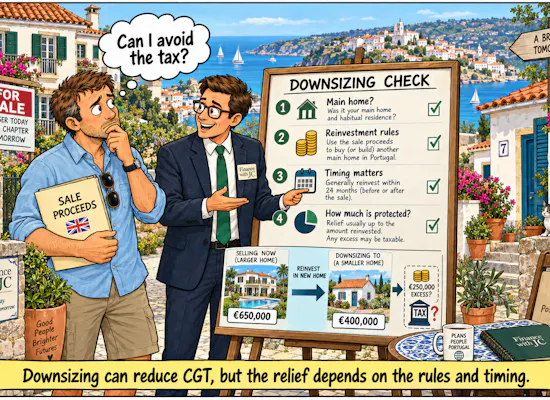
Downsizing rules may preserve RNRB if conditions met.
The planning logic
RNRB can still apply in certain downsizing scenarios.
A clean solution approach
Document sale value and maintain clear records for HMRC.
Takeaway
Selling property does not automatically remove RNRB.
Example 4
Situation
Long-term expat claims non-UK domicile. Estate £3 million, £800k in UK property.
The hidden risk
UK property remains within IHT scope regardless of domicile.
The numbers
- UK assets £800,000
- NRB £325,000
- RNRB may apply depending on descendants
- Taxable portion potentially significant
The planning logic
UK-situated assets carry UK IHT exposure even if non-domiciled.
A clean solution approach
Review ownership structure and potential asset restructuring.
Takeaway
UK property anchors IHT exposure.
Example 5
Situation
US-UK dual citizen in UAE with estate £4 million.
The hidden risk
Assumes UK bands apply cleanly without considering US estate tax interaction.
The numbers
US estate tax thresholds and treaty considerations complicate outcome.
The planning logic
Cross-border estate planning must coordinate UK and US systems.
A clean solution approach
Integrated UK-US estate review.
Takeaway
Dual nationality adds another layer.
How the Bands Work in Practice
How it works
- Determine domicile status.
- Identify UK-situated assets.
- Calculate NRB and transferable NRB.
- Assess RNRB eligibility.
- Apply tapering rules if estate exceeds £2m.
Key moving parts
- Domicile vs residency
- UK property ownership
- Direct descendants requirement
- Estate value taper above £2m
- Spousal transfer documentation
Trade-offs
- RNRB adds complexity.
- High estates lose RNRB through tapering.
- Gifting reduces estate but introduces timing risk.
What can go wrong
- Failing to transfer unused NRB from first spouse
- Losing RNRB through poor drafting
- Not understanding tapering rules
- Incorrect domicile assumptions
When it is not suitable
RNRB may not apply if:
- No direct descendants
- Estate exceeds taper limits significantly
- Property not qualifying residential interest
Checklist: How to evaluate this properly
- Confirm domicile status
- Confirm marital history and prior transfers
- Confirm direct descendants definition
- Check estate value vs £2m taper
- Confirm property qualifies
- Document downsizing evidence
What gets overlooked
- RNRB taper above £2m estate
- Lost transferable NRB due to admin failure
- Mixed families and stepchildren rules
- Overseas property not qualifying
- Incorrect trust structures blocking RNRB
- Failure to claim transferable bands
- Interaction with lifetime gifts
- Insurance policies inflating estate
How to stress-test what you already have
- Confirm current estate value
- Confirm domicile analysis
- Check UK property status
- Model £2m taper threshold
- Review spousal transfer records
- Confirm RNRB eligibility
- Review Will drafting
- Check beneficiary nominations
- Model 40% tax impact
- Review cross-border exposure
Common objections
“I live in Dubai so UK inheritance tax no longer applies.”
Emotional logic
IHT feels tied to where you live.
Practical risk
UK domicile keeps global estate in scope.
Next step
Confirm domicile status formally.
“The £1 million allowance applies to everyone.”
Emotional logic
Headline figures feel universal.
Practical risk
Only applies fully to married couples meeting conditions.
Next step
Calculate your personal allowance properly.
“I sold my UK house so I lost the RNRB.”
Emotional logic
Allowance must require a current house.
Practical risk
Downsizing provisions may still preserve it.
Next step
Review eligibility under downsizing rules.
“I have been abroad 15 years so I am non-domiciled.”
Emotional logic
Time abroad equals domicile change.
Practical risk
Domicile requires intention and permanence evidence.
Next step
Undertake structured domicile review.
“Property held abroad avoids UK IHT.”
Emotional logic
Location equals tax rule.
Practical risk
UK domicile can still bring global assets in scope.
Next step
Assess global exposure.
“I will deal with this when I return to the UK.”
Emotional logic
Delay feels safe.
Practical risk
Estate planning is needed now, not later.
Next step
Review thresholds immediately.
Decision framework
- Confirm domicile
- Value estate
- Identify UK assets
- Confirm marital transfer
- Confirm RNRB eligibility
- Model taper impact
- Review Will
- Review gifting
- Review cross-border exposure
If you only do 3 things this week
- Confirm residency status
- Calculate estate vs £2m taper
- Confirm spousal transfer eligibility
Self-diagnostic
Score 1 point per yes. Total possible 10.
- I understand my domicile status.
- I know if I am deemed domiciled.
- I know my estate value.
- I know if my estate exceeds £2m.
- I know if RNRB applies.
- I have documented spousal transfer.
- I understand downsizing rules.
- I have liquidity planning.
- I have reviewed US exposure if applicable.
- My Will aligns with RNRB rules.
Green 9–12
Amber 5–8
Red 0–4
What to do next based on score
Green
Keep it boring and maintain annual reviews.
Amber
Stress-test, adjust funding, and simplify.
Red
Redesign the plan before time increases cost.
FAQ
Quick definitions
Nil Rate Band (NRB)
The standard £325,000 inheritance tax allowance per person.
Residence Nil Rate Band (RNRB)
An additional allowance of up to £175,000 when a qualifying UK residence passes to direct descendants.
Long-term UK resident
Someone who has been UK tax resident for at least 10 out of the previous 20 tax years.
UK-situated assets
Assets legally located in the UK, including UK property and certain UK investments.
Inheritance Tax (IHT)
A 40% tax charged on estates above available thresholds.
RNRB taper
The reduction of the Residence Nil Rate Band when an estate exceeds £2 million.
Transferable Nil Rate Band
Unused NRB or RNRB from a deceased spouse that can pass to the survivor.
Downsizing relief
Rules allowing RNRB preservation even if a qualifying home was sold.
Direct descendants
Children, grandchildren, and certain stepchildren.
Within scope
Assets subject to UK IHT under current legislation.
Is UK inheritance tax based on residency?
No, not directly.
For deaths and chargeable transfers from 6 April 2025, HMRC looks at whether someone is a long-term UK resident, meaning UK tax resident in at least 10 of the previous 20 tax years. If they are long-term UK resident, their worldwide estate may fall within UK IHT scope. If not, UK IHT generally applies only to UK-situated assets.
What is the long-term UK residence rule for IHT?
It is a 10 out of 20 tax year test.
If you have been UK resident for at least 10 of the previous 20 tax years, you are treated as long-term UK resident for IHT purposes. That can bring overseas assets into UK IHT scope even if you are currently living abroad. Timing matters, particularly if you recently left the UK.
Does living in Dubai remove UK IHT exposure?
No.
UAE residency does not automatically remove UK IHT. If you are within scope under the long-term UK residence rules, your worldwide estate may be taxable. Even if you are not long-term UK resident, UK IHT can still apply to UK-situated assets such as UK property.
If I am not long-term UK resident, what is still taxed?
UK-situated assets remain within scope.
That includes UK residential property, certain UK shares, and other UK-based assets. Even long-term non-residents can face UK IHT on UK property. The NRB and possibly RNRB may still apply, but exposure does not disappear entirely.
Do expats still get the £325,000 Nil Rate Band?
Yes, if they are within UK IHT scope.
The Nil Rate Band applies whether you live in the UK or abroad, provided your estate is subject to UK IHT. If you are not within scope on worldwide assets, it may still apply against UK-situated assets.
Can expats use the Residence Nil Rate Band?
Yes, if strict conditions are met.
The RNRB applies where a qualifying UK residence passes to direct descendants. The property must meet HMRC’s definition of a qualifying residential interest. If you are not within UK IHT scope on worldwide assets, it may still apply to UK property. Estates above £2 million lose RNRB through tapering.
What happens if I sold my UK home years ago?
Downsizing relief may preserve RNRB.
If you previously owned a qualifying UK residence and later sold or downsized, you may still claim RNRB provided the estate passes assets to direct descendants and proper records are kept. Evidence of the former property value is important.
How does the £2 million taper affect expats?
It reduces the Residence Nil Rate Band.
For estates exceeding £2 million, the RNRB reduces by £1 for every £2 above that threshold. At £2.35 million for an individual, the RNRB is fully lost. For couples, taper planning becomes critical because exceeding the threshold can remove up to £350,000 of relief.
Can married couples combine allowances?
Yes.
Any unused Nil Rate Band and Residence Nil Rate Band from the first spouse can usually transfer to the survivor. That means a married couple could potentially access up to £1 million of combined relief, subject to eligibility and taper rules.
Does domicile still matter for IHT?
Yes, but its role has changed.
Before 6 April 2025, domicile largely determined worldwide IHT exposure. From 6 April 2025, long-term UK residence is the primary test. However, domicile concepts still matter in older estates and in certain trust contexts.
Are overseas properties eligible for the Residence Nil Rate Band?
No.
RNRB only applies to a qualifying UK residential property. A property in Dubai, South Africa, or elsewhere does not qualify for RNRB purposes, even if it is your main home.
What about UK pensions for expats?
It depends on the scheme.
Many defined contribution pensions are typically outside the estate for IHT, but this depends on scheme rules and control. Some pension structures or transfers may affect treatment. Always confirm with the scheme administrator.
Do US citizens in the UAE face additional complications?
Yes.
US citizens remain subject to US estate tax rules alongside UK rules where applicable. Coordination between the UK and US systems, and treaty considerations, becomes essential. Dual exposure risk must be modelled properly.
How can expats reduce IHT exposure legitimately?
Through structured planning, not avoidance.
Common tools include lifetime gifting, appropriate use of allowances, spousal transfers, insurance for liquidity, and ensuring RNRB eligibility. The key is aligning residence history, asset location, and estate documentation before thresholds are breached.
What should expats check immediately?
Check your residence history.
Confirm how many UK tax years you were resident in the last 20. Review whether you are long-term UK resident for IHT. Then list UK-situated assets and model estate value against NRB, RNRB, and taper thresholds.
References
https://www.gov.uk/guidance/inheritance-tax-if-youre-a-long-term-uk-resident
https://www.gov.uk/inheritance-tax/when-someone-living-outside-the-uk-dies
https://www.gov.uk/inheritance-tax
https://www.gov.uk/guidance/inheritance-tax-residence-nil-rate-band
https://www.gov.uk/guidance/inheritance-tax-deemed-domicile-rules
https://www.gov.uk/hmrc-internal-manuals/inheritance-tax-manual/ihtm46032
What happens next
Clarify objectives and liabilities
Define estate value, domicile and beneficiaries.
Quantify gaps and constraints
Model estate vs allowances and taper.
Structure and documentation alignment
Ensure Will drafting supports RNRB.
Underwriting or implementation review
Review trusts, gifts and insurance.
Ongoing review triggers and cadence
Review annually and on relocation or major life events.
Conclusion
For expats, the Nil Rate Band and Residence Nil Rate Band are powerful but conditional.
Domicile drives exposure.
Property ownership drives eligibility.
Structure drives outcome.
Assumptions are expensive. Clarity is not.
Compliance note
This is educational only and not personalised advice. UK inheritance tax rules depend on residency, asset location and individual circumstances. Tax law can change.
You may also like
Estate Planning for Expats
Returning to the UK - A Checklist for Expats
Class 2 National Insurance for UK Expats
https://financewithjc.com/blog/estate-planning-for-expats-2026-wills-guardianship-cross-border-assets
https://financewithjc.com/blog/returning-to-the-uk-checklist-for-expats
https://financewithjc.com/blog/class-2-nic-abolished-uk-expats
References
https://www.gov.uk/inheritance-tax
https://www.gov.uk/guidance/inheritance-tax-residence-nil-rate-band
https://www.gov.uk/inheritance-tax/gifts
https://www.gov.uk/guidance/deemed-domicile