What Is Universal Life Insurance?
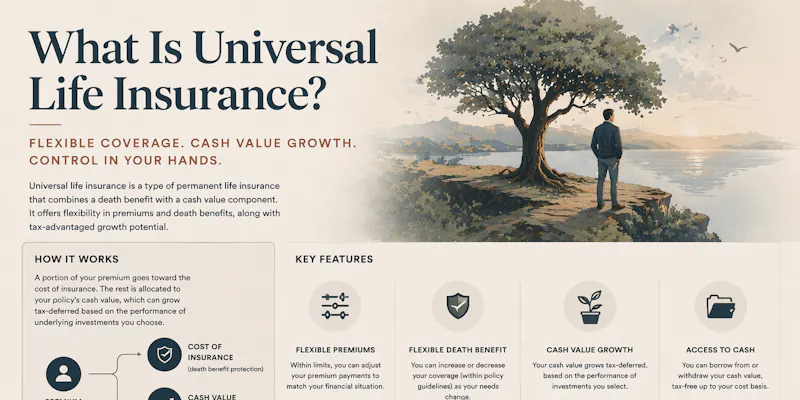
Universal life insurance is a form of permanent life insurance that combines a death benefit with a cash value element. For expats, it can be used for family protection, legacy planning, retirement flexibility, business continuity, and asset structuring, but it is not suitable for everyone.
At a glance
- Universal life insurance is permanent cover, not short-term protection.
- It combines a death benefit with a cash value component.
- It is often discussed for legacy planning, retirement flexibility, and business continuity.
- The appeal for expats is usually portability, liquidity, and cross-border planning.
- It can be useful, but only when the structure, cost, and objective are clear.
- It is not a substitute for emergency cash, proper investing, or a full estate plan.
- The wrong policy can be expensive, misunderstood, or poorly funded.
- The right policy can solve problems that ordinary term cover cannot.
People Also Ask
- What is universal life insurance in simple terms?
- How does universal life insurance work for expats?
- Is universal life insurance the same as term life insurance?
- Can universal life insurance help with retirement planning?
- Is universal life insurance good for business owners?
- When is universal life insurance not suitable?
What Is Universal Life Insurance?
Why this topic matters more than most expats realise
Universal life insurance sounds simple until you look at what people are actually trying to solve with it.
Usually, the real question is not “What is universal life insurance?” The real question is one of these:
- How do I protect my family if something happens while I am working overseas?
- How do I leave liquidity without forcing my family to sell assets at the wrong time?
- How do I create a more structured legacy if I may retire in a different country from the one I work in now?
- How do I balance protection, long-term planning, and flexibility?
I’m Josh, a financial planner specialising in expats in the Middle East. I join the dots across pensions, investments, tax, currency, insurance, and estate planning. I’m authorised to advise across the Middle East, the UK and the USA, framed around continuity when families move.
Universal life insurance sits in that continuity conversation.
In simple terms, universal life insurance is a type of permanent life insurance that offers a death benefit and a cash value element inside the same contract. In the Finance with JC guide, it is framed as a permanent policy that can provide protection and cash accumulation, with uses that may include family protection, retirement planning, stock market-linked growth, asset protection, and key person planning.
That does not mean everyone should have one.
The balanced answer is this. Universal life insurance can be powerful when you have a genuine long-term need for protection, liquidity, and structure. It can be a poor fit when it is bought as a fashionable investment idea, underfunded, or misunderstood.
Why expats in the Middle East need to think differently
Expats in Dubai, Abu Dhabi, Riyadh, Doha, Muscat, and across the GCC often have financial lives that are more fragmented than they look on paper.
You may earn in AED or USD, have liabilities in GBP, children studying elsewhere, pensions in the UK, investments offshore, and a spouse who may not stay in the same country if something happens to you. That means protection planning is rarely just about replacing salary.
What I see in practice is that expats often need insurance to do more than one job.
They may need it to:
- Protect a family lifestyle while overseas
- Create immediate liquidity on death
- Support school fees or mortgage continuity
- Sit alongside retirement planning
- Help with succession or business continuity
- Travel with them across jurisdictions more cleanly than local-only products
This is where universal life insurance becomes relevant. The uploaded guide positions it around family protection, retirement planning, key person insurance, diversification, and legacy planning, which is exactly why it comes up so often in cross-border conversations.
The trap is assuming that because a product is international, it is automatically suitable. It is not. Portability helps, but suitability still comes down to need, structure, affordability, and time horizon.
Five worked examples with numbers
Situation
A British solicitor in Dubai, aged 41, earns AED 85,000 a month. His spouse does not work, and school fees plus rent total AED 360,000 a year.
The hidden risk
He has strong income but very little guaranteed continuity if he dies unexpectedly. His employer death-in-service is only 24 months of salary.
The numbers
Two years of salary cover looks decent on paper, but the family’s fixed and lifestyle costs are around AED 1.1 million a year. That means employer cover gives roughly AED 2.04 million, or less than two years of real family spending once relocation, legal, and education costs are included.
The planning logic
A universal life policy may be considered where the client wants long-term cover rather than short-term cover only, and wants a structured legacy rather than a pure term solution that expires.
A clean solution approach
Layer basic term cover for immediate income replacement if needed, then assess whether a permanent policy is justified for long-term family liquidity and legacy planning.
Takeaway
Universal life insurance starts to make sense when the problem is permanent, not just temporary.
Situation
A law firm partner in Abu Dhabi has a net worth of GBP 2.8 million, including investments, UK pensions, and property. She wants to leave a defined legacy to two children and avoid a forced sale of assets on death.
The hidden risk
Most of her wealth is invested, but not all of it is liquid at the right time.
The numbers
If the family needs GBP 250,000 within the first year for tax, probate, fees, and household continuity, selling growth assets after a market fall could permanently damage the estate.
The planning logic
A universal life policy can create liquidity at the point it is needed, while other assets remain invested or are transferred more efficiently.
A clean solution approach
Map likely estate liquidity needs first, then decide whether permanent insurance is an efficient way to plug the gap.
Takeaway
Sometimes insurance is less about return and more about timing.
Situation
A business owner in the UAE has a company generating AED 4.5 million annual profit. One partner drives 40 percent of revenue.
The hidden risk
The business is exposed if that partner dies or becomes unavailable. Cash flow, lender confidence, and succession all become immediate issues.
The numbers
A 40 percent revenue contributor disappearing could create a short-term profit hit of AED 1.8 million, plus recruitment, debt, and operational strain.
The planning logic
The Finance with JC ULI guide explicitly notes key person insurance and buy-sell style uses as part of the conversation.
A clean solution approach
Calculate the commercial value of the key individual first, then decide whether permanent cover is justified or whether a simpler key person structure is enough.
Takeaway
For owners and partners, insurance can be a business continuity tool, not just a family tool.
Situation
A couple plan to retire between Portugal and the UAE in ten years. They already invest USD 4,000 a month and want an additional structure for legacy and retirement flexibility.
The hidden risk
They are tempted to treat universal life insurance as their primary investment plan.
The numbers
If they overfund the wrong product at the expense of pensions and simpler investment accounts, they could lock too much capital into a structure that does not give them the same flexibility they expected.
The planning logic
Universal life insurance may complement retirement planning. It should not automatically replace straightforward investing.
A clean solution approach
Build retirement using the right core vehicles first. Then decide whether permanent insurance adds a distinct planning benefit.
Takeaway
A useful product becomes a bad product when it is asked to do every job.
Situation
A 34-year-old single expat in Dubai with no dependants wants universal life insurance because he saw a social media post about tax-free wealth building.
The hidden risk
This is a wrong fit scenario. He has no legacy need, modest surplus cash, and no business continuity need.
The numbers
He can save AED 8,000 a month but has only four months of emergency cash and no clear long-term residence plan.
The planning logic
He may need emergency reserves, disability protection, and disciplined investing before he needs permanent life insurance.
A clean solution approach
Stabilise cash flow, build an emergency fund, protect income, and invest efficiently first.
Takeaway
Not suitable is a valid outcome. Good planning includes saying no.
How universal life insurance works for expats in practice
How it works in practice
At its core, universal life insurance is a permanent insurance contract. Part of the discussion is the death benefit, which is what the beneficiaries may receive if the insured dies while the policy is in force. Another part is the internal value that may build within the policy over time.
That is why it sits somewhere between pure protection and longer-term planning.
The uploaded guide describes it as a permanent insurance policy with death benefit protection and potential cash accumulation, and highlights common use cases such as family protection, retirement planning, asset protection, diversification, and business-related planning.
The key moving parts
There are five moving parts that matter most.
First, the objective. Are you solving for family protection, estate liquidity, legacy planning, business continuity, or retirement flexibility?
Second, the funding level. A permanent policy only works well when it is funded sensibly and reviewed properly.
Third, the time horizon. These are not usually products for people who may cancel after two or three years.
Fourth, policy charges and structure. The internal mechanics matter. If you do not understand costs, you do not understand the product.
Fifth, jurisdiction and portability. For expats, this matters more than most brochures admit. A policy should be stress-tested against future moves, future tax residence, and future family needs.
Trade-offs
There is no free lunch here.
The advantages often include:
- Permanent cover rather than temporary cover
- Potential liquidity on death
- Flexibility for legacy planning
- Relevance for certain business or succession scenarios
- Potential usefulness within a broader retirement conversation
The disadvantages often include:
- Higher complexity than plain term insurance
- Cost if the structure is wrong or poorly funded
- Long-term commitment
- Mis-selling risk when sold as a shortcut to investment success
- Confusion between guaranteed features and hoped-for outcomes
What can go wrong
What I see in practice is rarely a product failure in isolation. It is usually a planning failure.
Common failure modes include:
- Buying it for the wrong reason
- Underfunding it
- Ignoring charges
- Treating it as a replacement for emergency cash
- Overestimating liquidity
- Assuming it solves estate planning by itself
- Forgetting future residence changes
When it is not suitable
Universal life insurance is not suitable when:
- You have no real need for long-term life cover
- You mainly need cheap income replacement for a defined period
- You do not have stable cash flow
- Your emergency reserve is weak
- You want simple, transparent investing rather than a hybrid planning tool
- You are likely to lapse the policy early
- You do not understand the structure and do not want to learn it
Checklist: How to evaluate this properly
- Start with the problem you are solving, not the product name.
- Check whether the need is temporary or permanent.
- Review all existing employer cover before adding anything new.
- Model family cash needs in AED, GBP, and USD if your life is multi-currency.
- Stress-test affordability if income drops or you relocate.
- Ask how the policy fits alongside pensions, investments, wills, and business planning.
- Review portability if you move from the UAE to the UK, Europe, or elsewhere.
- Check who the beneficiary is, how proceeds would be paid, and how quickly.
- Understand whether you are paying mainly for protection, planning flexibility, or both.
What gets overlooked
- Employer cover often disappears when you change jobs.
- Local policies may not travel cleanly across jurisdictions.
- A spouse may need liquidity immediately, not after probate.
- A business owner’s insurance need is often larger than personal salary replacement.
- School fees are usually one of the biggest overlooked liabilities.
- The wrong policy can crowd out better savings decisions.
- Insurance that is never reviewed becomes outdated fast.
- A policy is only one piece of a cross-border estate plan.
- Children, guardianship, and wills still need separate work.
How to stress-test what you already have
- Check portability if you leave your current country of residence.
- Review jurisdiction risk across all insurance and investment arrangements.
- Confirm beneficiary alignment with your will and estate plan.
- Measure currency risk against your family’s likely future spending.
- Review total charges, not just the sales illustration headline.
- Make sure documentation is accessible to your spouse or executors.
- Assess counterparty risk and policy provider strength.
- Confirm review cadence at least annually.
- Check how the policy behaves if funding stops.
- Understand surrender implications and exit pain.
- Review whether the cover amount still matches liabilities.
- Compare it against term cover and straightforward investing.
- Confirm whether it is supporting retirement planning or distorting it.
- Check whether business and personal insurance needs have been mixed together badly.
Common mistakes
- Buying before defining the objective
why it matters: confusion at outset creates disappointment later. - Using permanent insurance to solve a short-term need
why it matters: you may overpay for the wrong kind of cover. - Ignoring employer benefits
why it matters: duplicate cover wastes cash. - Treating policy illustrations as guarantees
why it matters: planning around optimistic assumptions is dangerous. - Underfunding the contract
why it matters: poor funding can weaken the long-term outcome. - Failing to review after relocation
why it matters: your residence, currency, and estate needs may all have changed. - Forgetting spouse and beneficiary administration
why it matters: a good plan still fails if nobody can access it properly. - Mixing business needs with personal needs without clarity
why it matters: ownership and beneficiary errors create avoidable disputes. - Expecting it to replace pensions and investments
why it matters: it is usually a complement, not a complete strategy. - Buying because of a tax slogan online
why it matters: slogans are not planning.
Common objections
Objection
“Quoted statement”
“Universal life insurance is just expensive life cover.”
Emotional logic
You do not want to pay for complexity you do not need.
Practical risk
Sometimes that is true. Sometimes the permanent liquidity and planning value are exactly why it is chosen.
Next step
Compare the cost against the actual long-term problem you are solving.
Objection
“Quoted statement”
“I already have insurance through work.”
Emotional logic
Employer cover feels easy and sufficient.
Practical risk
It may vanish when you change employer, country, or contract.
Next step
List what cover is genuinely portable and personally owned.
Objection
“Quoted statement”
“I would rather just invest the money.”
Emotional logic
Straight investing feels cleaner.
Practical risk
Investments do not automatically create guaranteed liquidity on death.
Next step
Separate wealth-building goals from liquidity and protection goals.
Objection
“Quoted statement”
“This sounds too complicated.”
Emotional logic
Complexity feels like danger.
Practical risk
Avoiding complexity is sensible, but ignoring a real planning gap is not.
Next step
Reduce the decision to objective, funding, timeframe, and portability.
Objection
“Quoted statement”
“I’m too young to think about legacy planning.”
Emotional logic
Legacy feels like a later-life issue.
Practical risk
For expats with children or liabilities, liquidity planning matters now.
Next step
Model what your family would need in year one if you died tomorrow.
Objection
“Quoted statement”
“I only need something cheap.”
Emotional logic
Cost control is rational.
Practical risk
Cheap is useful only if it solves the right problem.
Next step
Decide whether your need is temporary cover or permanent planning.
Objection
“Quoted statement”
“This must be for ultra-high-net-worth families.”
Emotional logic
Sophisticated products feel like somebody else’s world.
Practical risk
It is more about problem type than status label.
Next step
Assess needs based on dependants, liquidity, and business exposure.
Objection
“Quoted statement”
“I’ll deal with insurance once I know where I’ll retire.”
Emotional logic
Delay feels efficient.
Practical risk
Uncertainty is exactly why portability matters.
Next step
Build a plan that can survive at least two likely future jurisdictions.
Decision framework
- Define the exact problem you are trying to solve.
- Decide whether the need is temporary or permanent.
- Review all existing cover and employer benefits.
- Quantify liabilities, family spending, and liquidity needs.
- Test whether term insurance alone solves it.
- If not, assess whether universal life insurance adds a distinct benefit.
- Review funding, affordability, and long-term commitment.
- Stress-test the policy against relocation and currency changes.
- Align beneficiaries, estate planning, and business arrangements.
- Review annually and after every major life event.
If you only do 3 things this week
- Write down what financial problem you think insurance should solve.
- Add up your family’s required one-year cash need if you died tomorrow.
- Check exactly what cover you already have through work and whether it follows you.
Self-diagnostic
Score 1 point for each yes answer. Total possible points: 12.
- Do you know whether your insurance need is temporary or permanent?
- Do you know how much employer cover you already have?
- Do you have dependants or liabilities that would create a genuine liquidity need?
- Have you reviewed your cover in the last 12 months?
- Do you have stable cash flow to support long-term planning?
- Do you understand the difference between protection and investing?
- Have you stress-tested future moves across jurisdictions?
- Are beneficiaries and estate documents aligned?
- Do you know what currency your family would spend in if something happened?
- Have you separated personal and business insurance needs?
- Do you understand the charges and structure of any existing policy?
- Do you know when universal life insurance would be a bad fit for you?
Green 9–12
Amber 5–8
Red 0–4
What to do next based on score
Green
Keep it boring and maintain annual reviews.
Amber
Stress-test, adjust funding, and simplify.
Red
Redesign the plan before time increases cost.
FAQ
Quick definitions
Universal life insurance
A permanent life insurance policy with a death benefit and internal cash value element.
Death benefit
The amount payable to beneficiaries when the insured dies, subject to policy terms.
Cash value
The internal value that may build within the policy over time.
Permanent insurance
Insurance designed to remain in place long term rather than for a fixed short term.
Key person insurance
Insurance used to protect a business against the loss of a critical individual.
What is universal life insurance in simple terms?
It is permanent life insurance with an added planning layer. It provides a death benefit and may build internal value over time. That is why it is often used for more than pure income replacement. For expats, it usually comes up in conversations around family protection, legacy, retirement flexibility, and liquidity.
Is universal life insurance the same as term life insurance?
No, they solve different problems. Term insurance is usually simpler and designed for a fixed period. Universal life insurance is generally built for longer-term or permanent needs. The right choice depends on whether you need cheap temporary cover or a more lasting planning tool.
How does universal life insurance work for expats?
It works best when it solves a cross-border planning problem. That may include family protection overseas, legacy planning, business continuity, or estate liquidity. The reason expats look at it is usually portability and flexibility. The reason some should avoid it is complexity and poor fit.
Can universal life insurance help with retirement planning?
Sometimes, yes. It can form part of a broader retirement conversation, especially where flexibility and long-term structuring matter. But it should not automatically replace pensions, investing, and cash reserves. Retirement planning usually works best when insurance plays a supporting role rather than doing all the heavy lifting.
Is universal life insurance good for business owners?
It can be, especially where a business needs continuity capital. The Finance with JC material specifically links it to key person protection and buy-sell style planning conversations. That matters for owners whose business depends on a small number of people. The cover should still be calculated from business reality, not guesswork.
Is universal life insurance mainly an investment?
No, that is a poor starting point. It may include a growth or cash value element, but it remains an insurance contract first. When people buy it only because they heard it is tax-efficient or market-linked, disappointment usually follows. Start with the protection or liquidity need, then assess the planning value.
Who is universal life insurance usually suitable for?
It is usually suitable for people with a genuine long-term need. That may include families with dependants, people with estate liquidity concerns, or business owners with continuity issues. It can also suit expats who want something more portable than a local-only solution. Suitability still depends on affordability and time horizon.
When is universal life insurance not suitable?
It is not suitable when you mainly need short-term cheap cover. It is also a poor fit if your cash flow is unstable, your emergency reserve is weak, or you are likely to cancel early. In those cases, simpler insurance and simpler investing are often better. Not every planning question needs a permanent solution.
Is universal life insurance guaranteed to perform well?
No. You should never treat sales illustrations as guaranteed outcomes. Good advice means understanding what is contractual, what is projected, and what depends on funding and time. That distinction matters a lot. Many policy disappointments start with misunderstood expectations.
Can it help with legacy planning?
Yes, that is one of the common reasons it is used. A permanent policy can provide a defined amount of liquidity to beneficiaries without forcing other assets to be sold quickly. That can be especially helpful for cross-border families. Legacy planning is about timing and clarity, not just total net worth.
What is the difference between universal life insurance and whole of life?
Both are forms of permanent insurance, but their design and flexibility can differ. The important point for most expats is not product jargon. It is whether the policy fits the objective, funding level, and jurisdiction profile. Start with planning needs before comparing labels.
Can universal life insurance replace term insurance?
Not always. In many cases, the best answer is a combination rather than an either-or choice. A family may use term cover for temporary income replacement and keep permanent insurance for legacy or liquidity planning. Layering can be more sensible than forcing one product to do everything.
Does universal life insurance solve estate planning on its own?
No. It can support estate planning, but it does not replace wills, guardianship, trusts, powers of attorney, or beneficiary reviews. Insurance is one piece of the system. If the rest of the system is weak, the policy cannot fix that alone. This matters even more for families living across borders.
Should young expats consider universal life insurance?
Only if there is a real long-term need. Age alone does not make it right or wrong. Dependants, liabilities, business exposure, and future planning complexity matter more. Many younger expats need emergency reserves and income protection before they need permanent life insurance.
What happens next
Clarify objectives and liabilities
Identify whether the problem is family protection, estate liquidity, retirement flexibility, business continuity, or a mix of these.
Quantify gaps and constraints
Measure existing cover, family spending, liabilities, employer benefits, and what happens if income stops.
Structure and documentation alignment
Make sure beneficiaries, wills, business arrangements, and the policy ownership all point in the same direction.
Underwriting or implementation review
Review health, affordability, provider quality, contract structure, and long-term funding discipline before anything is put in place.
Ongoing review triggers and cadence
Review after marriage, children, relocation, job changes, business changes, large debts, or any major shift in net worth.
You may also like
Critical Illness vs Income Protection for Expats
Whole of Life vs Term Life for IHT Planning
Conclusion
Universal life insurance is not magic, and it is not for everyone. But for the right expat family, business owner, or internationally mobile professional, it can solve a very specific set of problems that ordinary term cover or ordinary investing do not solve cleanly.
The key is to be honest about what you are trying to achieve. If you need cheap short-term cover, say that. If you need long-term liquidity, legacy planning, or business continuity capital, say that too. Good planning gets easier when the objective is clear.
If you are living in the UAE or wider Middle East and want to understand whether universal life insurance is genuinely suitable for you, speak to Josh Clancey about a proper cross-border review. That conversation can help you separate sales language from real planning value, identify whether the structure fits your family or business, and decide what should happen next before you commit to the wrong policy.
Compliance note
This article is for general information only and is not personal financial, tax, or legal advice. Insurance suitability depends on your objectives, health, cash flow, jurisdiction, and wider financial plan.
You may also like
Whole of Life vs Term Life for IHT Planning in 2026
Premium Financing Life Insurance Explained (2026): Risks and Uses
Whole of Life for Inheritance Tax Planning (2026): Who It Suits