Key takeaways
Last updated: 25 January 2026
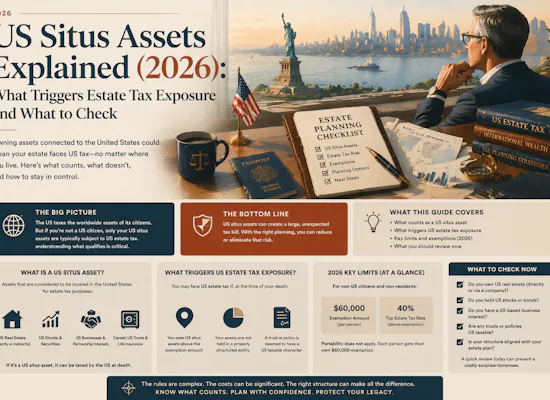
- US situs assets are what matter for estate tax. US real estate, stock in US corporations, and US-domiciled mutual funds or ETFs generally count as US situs. Brokerage location does not change this.
- Some assets are typically not US situs for nonresident decedents. Bank deposits held in US banks, certain qualifying portfolio debt obligations, and life insurance proceeds on the life of a nonresident are excluded by statute.
- Nonresident estates get only a 60,000 USD exemption for US situs assets. Amounts above that face progressive estate tax rates up to 40 percent. Filing Form 706-NA is required if US assets exceed 60,000 USD.
- US citizens and residents currently have a 13.99 million USD basic exclusion amount for 2025. That figure is separate from the 60,000 USD NRA exemption.
- Treaties can improve the nonresident position. A number of countries including the UK, Ireland, Germany, France, South Africa, and others have estate or gift tax treaties with the US that may grant higher exemptions or credits.
- Dividend withholding on US-source payments to nonresidents is 30 percent by default. Treaty rates can reduce this with proper W-8 documentation.
- Capital gains are generally not taxed to nonresidents unless tied to US real property or the 183-day special rule applies. Real property gains are taxed under FIRPTA and ordinary portfolio gains are usually not, unless presence and tax-home tests are met.
- Rental income from US real estate paid to nonresidents is subject to 30 percent withholding on gross unless you elect net taxation as effectively connected income.
- US-domiciled funds are typically US situs. Foreign-domiciled funds that hold US stocks, such as Irish UCITS ETFs, are generally not US situs for estate tax even though they give similar exposure. Verify fund domicile on the factsheet.
- ADR mechanics matter. Shares of foreign corporations, including many ADRs issued for non-US companies, are not US situs. ADRs for US corporations are still US situs.
- Practical ways to limit estate exposure include using non-US-domiciled funds for US equity exposure, holding qualifying portfolio debt, and recognising that life insurance death benefits on a nonresident are non-US situs by statute. Always coordinate with cross-border tax counsel.
For international investors, the United States represents an attractive market offering stability, growth potential, and diversification benefits. However, investing in US assets carries unique tax considerations that many non-resident aliens (NRAs) overlook until it's too late.
The concept of "US situs assets" is particularly critical, as these US-based investments can trigger significant estate tax liabilities even for individuals who have never lived in or visited the United States. With non-resident aliens subject to dramatically lower estate tax exemptions than US citizens, understanding these rules becomes essential for effective wealth preservation and transfer planning.
This comprehensive guide explains what constitutes a US situs asset, the potential tax implications, and practical strategies to mitigate exposure to US estate taxes while maintaining access to American investment opportunities.
What Are US Situs Assets? Understanding the Core Concept
In international tax law, "situs" refers to the location where an asset is situated for legal and tax purposes. For the United States, certain assets are classified as US situs assets, subjecting them to US tax jurisdiction regardless of the owner's citizenship or residency status.
Assets Classified as US Situs Assets
The following investments and property types are generally considered US situs assets and potentially subject to US estate taxation when owned by non-resident aliens:
- US Real Estate - All physical property located within US borders, including residential homes, commercial buildings, and undeveloped land
- Shares of US Corporations - Stocks issued by companies incorporated in the United States, even if purchased on foreign exchanges
- Tangible Personal Property - Physical items located in the US such as artwork, jewelry, vehicles, and collectibles
- US Business Interests - Ownership stakes in US partnerships, LLCs, and other American business entities
- US-Issued Debt Securities - Corporate bonds issued by US companies (with certain exceptions)
- US-Domiciled Investment Funds - Mutual funds and ETFs organised under US law, regardless of where the underlying investments are located
Assets Exempt from US Situs Classification
Importantly, several asset categories are not considered US situs assets, providing planning opportunities for non-resident aliens:
- Foreign Corporation Shares - Stock in non-US companies, even if traded on US exchanges (e.g., via ADRs)
- US Bank Deposit - Cash held in American banking and savings institutions
- US Treasury Bonds - Certain government debt instruments receive special exemption under the tax code
- Life Insurance Policies - Death benefits from policies issued by US insurance companies
- Foreign Mutual Funds and ETFs - Investment funds organised under non-US law, even if they invest primarily in US assets
Many non-resident investors mistakenly assume that all assets held in the United States are subject to US estate tax. Understanding these distinctions enables more effective tax planning while maintaining exposure to US markets.
Estate Tax Implications for Non-Resident Aliens
The most significant concern regarding US situs assets for non-resident aliens is their exposure to US estate tax upon death. This exposure exists even if the individual has never resided in or visited the United States.
The $60,000 Exemption Limitation
The disparity in estate tax treatment between US persons and non-resident aliens is dramatic:
- US Citizens and Residents - Currently enjoy an estate tax exemption of $13.61 million (as of 2025)
- Non-Resident Aliens - Limited to a mere $60,000 exemption for US situs assets
This means that a non-resident alien with more than $60,000 in US situs assets could subject their heirs to US estate tax liability, with rates ranging from 18% to 40% on the excess value.
Calculating Potential Estate Tax Exposure
To understand the potential impact, consider this example:
A British investor with no US connections holds:
- $800,000 in US stocks (Apple, Microsoft, and Amazon)
- $350,000 in a Miami condo
Total US situs assets: $1,150,000
Estate Tax Calculation:
- Taxable amount: $1,090,000 ($1,150,000 minus $60,000 exemption)
- Approximate estate tax due: $386,800 (based on progressive rates up to 40%)
This substantial tax liability would apply despite the investor having no other connections to the US tax system, potentially creating a forced liquidation scenario for heirs.
Strategies to Minimise US Estate Tax Exposure
With proper planning, non-resident aliens can significantly reduce or eliminate US estate tax exposure while maintaining investment exposure to US markets.
Utilise Foreign Holding Structures
One of the most effective approaches involves creating appropriate legal structures to hold US investments:
Offshore Portfolio Bonds - Holding the shares through an offshore portfolio bond, which offers protection from US Estate Duty.
Foreign Partnerships - May provide similar benefits with different tax treatment
Trusts - Irrevocable foreign grantor trusts can provide estate tax protection in certain circumstances
Example Implementation: An investor might establish an Isle of Man portfolio bond to purchase and hold US stocks or property. Upon death, the investor's heirs would receive the funds through a nomination form.
Leverage Foreign Investment Vehicles
For those primarily interested in investment exposure rather than direct ownership:
- Foreign-Domiciled ETFs and Mutual Funds - Funds established in countries like Ireland or Luxembourg often provide nearly identical investment exposure to US markets
- UCITS Funds - European regulatory framework offering similar diversification benefits
- Non-US Listed Securities - Many large US companies trade on international exchanges
Practical Example: Rather than purchasing shares of Apple directly, an investor might select an Ireland-domiciled ETF that tracks the S&P 500 or US technology sector, achieving similar investment exposure without creating US situs assets.
Utilise Tax Treaties for Enhanced Protection
The United States maintains estate tax treaties with several countries that can significantly improve the position of non-resident aliens:
- Increased Exemption Amounts - Many treaties provide exemptions far above the standard $60,000
- Marital Deductions - Some treaties extend marital deduction benefits to non-citizen spouses
- Credit Mechanisms - Provisions to prevent double taxation between jurisdictions
Treaty Countries Include: Australia, Austria, Canada, Denmark, Finland, France, Germany, Greece, Ireland, Italy, Japan, Netherlands, South Africa, Switzerland, and the United Kingdom.
Treaty Benefit Example: A UK resident might benefit from a prorated exemption based on the ratio of their US assets to their worldwide assets, potentially giving a higher exemption.
Additional Tax Considerations for US Investments
Beyond estate tax, non-resident aliens should be aware of other US tax implications when investing in American assets.
Income Tax and Withholding Requirements
- Dividend Withholding - Non-resident aliens typically face 30% withholding on US-source dividends, though tax treaties may reduce this rate
- Interest Income - Most interest paid to non-resident aliens is exempt from US withholding tax
- Capital Gains - Generally not taxable for non-resident aliens except for US real property interests
- Rental Income - Subject to US income tax, typically at a 30% withholding rate on gross rents unless an election is made to pay tax on net rental income
Gift Tax Considerations
The US gift tax regime treats non-resident aliens differently than the estate tax system:
- Intangible Assets - Gifts of intangible assets (including US stocks) are generally exempt from US gift tax for non-resident aliens
- Real Property and Tangible Personal Property - Gifts of US real estate and tangible personal property located in the US remain subject to US gift tax
- Annual Exclusion - The standard annual gift tax exclusion ($18,000 per recipient for 2025) applies
This difference creates planning opportunities, as lifetime gifts of US stocks can effectively remove these assets from potential estate tax exposure.
Practical Implementation of US Situs Asset Planning
Developing an effective strategy for managing US situs assets requires a coordinated approach involving several key steps.
Step 1: Comprehensive Asset Inventory
Begin by cataloguing all potential US situs assets across various categories:
- Direct investments in US stocks, bonds, and funds
- Real estate holdings within the United States
- Tangible personal property located in America
- Business interests in US entities
This inventory should include not just current holdings but also anticipated future investments to develop a forward-looking strategy.
Step 2: Quantify Potential Tax Exposure
Calculate your potential estate tax liability based on:
- Current value of US situs assets
- Applicable exemption amount (standard $60,000 or treaty-enhanced amount)
- Progressive tax rates applied to the excess
- Present value of projected future tax liability
This quantification helps determine whether restructuring is warranted based on the potential tax savings versus implementation costs.
Step 3: Evaluate Alternative Structures
For each category of US situs assets, consider alternative holding methods:
- Foreign blocker corporations for investment portfolios
- Foreign partnership structures for active business interests
- Non-US funds providing similar investment exposure
- Life insurance solutions incorporating US assets
Compare the tax benefits, ongoing compliance requirements, and implementation costs of each approach.
Step 4: Implementation with Professional Guidance
Successful implementation typically requires coordinated advice from:
- US international tax specialists and estate planners
- Cross-border investment advisors familiar with both jurisdictions
- Corporate service providers in relevant offshore jurisdictions
Proper documentation and ongoing maintenance of any structures are essential to ensure their effectiveness for estate tax purposes.
Securing Your International Investment Strategy
US situs asset planning represents a critical component of comprehensive wealth management for non-resident aliens investing in American markets. While the substantial disparity between the $60,000 exemption for non-residents and the multi-million dollar exemption for US persons creates significant tax exposure, proper planning can effectively mitigate these risks.
By implementing appropriate holding structures, leveraging tax treaties, and selecting tax-efficient investment vehicles, international investors can maintain exposure to the opportunities presented by US markets while protecting their wealth from unexpected estate tax consequences.
As with all international tax planning, the optimal approach depends on your specific circumstances, investment objectives, and applicable treaty provisions. Working with qualified advisors familiar with both US tax law and your home country's requirements ensures that your strategy is both effective and compliant.
FAQs
Does the US estate tax apply even if I've never visited the United States? Yes, US estate tax liability is determined by the classification of your assets as US situs property, not by your physical presence or activities in the United States. Even investors who have never set foot in America may face estate tax exposure if they directly own US stocks, real estate, or other qualifying assets.
Can I avoid US estate tax by simply holding my investments in a foreign brokerage account? Unfortunately, the location or nationality of your brokerage firm doesn't affect the classification of US situs assets. US stocks remain US situs assets regardless of where the brokerage account is maintained. However, holding foreign-domiciled funds that invest in US markets through a foreign brokerage may provide a solution.
How do I know if an ETF is US-domiciled or foreign-domiciled? Check the fund's prospectus or fact sheet for its country of incorporation and regulatory framework. US-domiciled funds typically have a prospectus filed with the SEC and often include "Inc." or "Trust" in their legal names. Foreign-domiciled alternatives are often structured under UCITS (for European funds) or other non-US regulatory frameworks, with identifiers like "plc" or "SICAV" in their names.
Sources
Useful Calculators / Tools
Insurance Calculator
Retirement Readiness
Investment Growth
Final Salary Transfer Value Estimator
Education Fee Calculator
Finance Decoder (Jargon Buster)
Portfolio Reviewer
Lost Asset Tracker