Retirement Planning for Americans Abroad (2026): Complete Guide
Americans living abroad can keep and use 401(k)s, IRAs, Roth accounts, and Social Security, but the plan must account for US tax rules, host-country tax treatment, currency risk, and reporting. The most common mistakes are assuming the FEIE removes all US tax issues, ignoring Roth and treaty nuances, and failing to plan distributions, withholding, and beneficiary designations.
At a glance
- You can keep US retirement accounts while abroad, but tax and reporting still follow you
- The FEIE can reduce US taxable earned income, which can reduce IRA contribution room
- Roth decisions are often treaty-driven and country-specific
- Social Security can be paid abroad, but there are country and status rules to understand
- Currency and sequence risk matter more when your spending currency is not USD
- Your plan should include beneficiary, estate, and admin execution steps, not only investments
People Also Ask
- Can Americans abroad still contribute to an IRA or Roth IRA?
- Does the FEIE affect IRA contributions?
- Can I keep my 401(k) when I leave the US?
- Will Social Security pay me if I live overseas?
- Should I do Roth conversions while living abroad?
- How do I avoid double taxation on US retirement withdrawals?
The expat retirement problem
Americans abroad have a unique retirement challenge:
your life is international, but your retirement system is still American.
That creates four recurring friction points:
- tax rules that follow you
- host-country rules that may not recognise US wrappers cleanly
- USD assets funding non-USD spending
- admin, beneficiaries, and execution across borders
If you ignore those, you can still save a lot and still end up with a messy retirement.
I’m Josh, a financial planner specialising in expats in the Middle East. I join the dots across pensions, tax, currency, investments, insurance, and estate planning so globally mobile clients stop guessing and start making confident decisions. I am authorised and able to advise clients across the Middle East, the UK, and the USA, which helps when your retirement plan must stay coherent through moves and changing residency.
This guide is educational only, not personalised advice. US and local tax rules can change. Treat this as your planning framework, then get regulated advice for your specific countries and accounts.
How US retirement accounts behave when you live overseas
The simple truth: you can keep most accounts, but the rules do not pause
Leaving the US generally does not force you to close a 401(k) or IRA.
What changes is the context:
- you may not be able to contribute in the same way
- your host country may tax distributions differently
- some countries may not respect Roth treatment
- reporting and withholding can become more complex
- your currency exposure becomes a first-order risk
401(k): what usually stays the same, and what changes
What usually stays the same
- Your existing 401(k) remains invested.
- You can generally keep the plan with the employer’s provider.
- Distributions are still governed by US rules.
What changes in practice
- Investment choice may be limited compared to an IRA.
- Old employer plans can have higher fees or outdated fund menus.
- Rolling to an IRA can improve control, but it is not always best if your plan has exceptional institutional pricing, unique funds, or strong creditor protection features.
Traditional IRA: the core expat wrapper, with contribution constraints
Traditional IRAs are often a flexibility tool for Americans abroad.
But contributions depend on compensation rules and tax position. If you use the FEIE and reduce taxable compensation, you can unintentionally reduce IRA contribution eligibility.
Also, deductibility of contributions depends on income and coverage by a workplace plan, and it is sensitive to your filing status.
Roth IRA: the most misunderstood expat asset
Roth accounts are simple in the US: pay tax now, tax-free qualified withdrawals later.
Overseas, Roth becomes a treaty question.
In some countries, Roth may be treated as:
- tax-free (best case)
- partially taxed (mixed treatment)
- fully taxable (worst case)
- or taxed unfavourably on gains
That is why a Roth strategy that is brilliant in Florida can be a headache in Europe or elsewhere.
RMDs: expat admin pain, not just a tax concept
If you are subject to RMDs, living abroad adds operational risk:
- getting distributions processed on time
- withholding and paperwork
- banking transfers across borders
- proof of life or identity checks in some cases
- aligning distributions with local tax deadlines
RMD failure penalties can be severe, so you build an admin system, not just an investment plan.
The expat tax levers that decide your retirement outcome
FEIE vs Foreign Tax Credit: why this matters for retirement planning
This is a planning trap.
- The FEIE can reduce US taxable earned income.
- The Foreign Tax Credit offsets US tax with foreign taxes paid.
The retirement planning relevance:
- FEIE can reduce or eliminate taxable compensation for IRA contribution purposes, depending on your fact pattern.
- FTC strategies can preserve taxable compensation while still avoiding double taxation, which can improve retirement contribution options and long-term planning flexibility.
You do not choose FEIE vs FTC based on a headline benefit. You choose it based on your long-term plan, including retirement account contributions and future Roth planning.
Treaty reality: retirement taxation is country-specific
Treaties often control:
- whether distributions are taxed in the US, the host country, or both
- what withholding applies
- how pensions are classified
If you move countries, the treaty changes. That means your “perfect plan” may need a redesign after relocation.
Reporting: you can be compliant and still make poor decisions
FBAR and FATCA are compliance issues, not retirement strategy.
Being compliant does not mean you have a good plan.
Your goal is:
- compliant
- tax-efficient
- currency-aligned
- executable for your family
Five worked examples with numbers
Worked example 1: The FEIE trap reduces IRA contribution room
Situation
A US citizen in Dubai earns USD 180,000 and uses the FEIE to exclude a large portion of earned income. They want to contribute to an IRA each year and build a Roth strategy.
The hidden risk
By excluding earned income, they reduce the taxable compensation that can support IRA contributions, depending on their exact filing and compensation structure.
The numbers
- Earned income: $180,000
- IRA contribution limit for 2026: $7,500 (plus catch-up rules for age 50+)
- Intended contribution: $7,500
- Excluded earned income under FEIE: large enough that taxable compensation may be reduced (fact-dependent)
The planning logic
- Confirm what counts as compensation for IRA purposes in your filing situation
- Model FEIE vs FTC outcomes, not just for this year, but for a 5-year plan
- Choose the approach that supports your long-term retirement funding strategy
- Keep documentation and a repeatable annual process
A clean solution approach
Treat FEIE vs FTC as a retirement planning decision, not just a tax return choice. If IRA contributions and Roth planning matter, confirm your compensation position before locking in the approach.
Takeaway
You can lower tax and accidentally lower your retirement options.
Worked example 2: Roth conversions abroad to use a lower-tax window
Situation
An American living in a low-tax jurisdiction plans to return to a higher-tax state in the US in 3 years. They hold $600,000 in a traditional IRA and expect higher US tax rates later.
The hidden risk
They delay conversions, then convert later when US taxes are higher and local treatment is less favourable.
The numbers
- Traditional IRA: $600,000
- Target conversion: $60,000 per year for 3 years
- Total converted: $180,000
- If the effective tax rate difference is 10% (illustrative), tax saved could be $18,000 on converted amounts
The planning logic
- Identify the tax window while abroad
- Confirm host-country treatment of Roth conversions and future Roth withdrawals
- Stage conversions to manage brackets and avoid cliff effects
- Coordinate with Social Security timing and future RMD planning
A clean solution approach
Use staged conversions only when treaty and local tax treatment support the strategy and the plan remains coherent if you move again.
Takeaway
Roth conversion strategy is a country strategy, not just a US strategy.
Worked example 3: Currency mismatch turns a good portfolio into a bad retirement
Situation
A retired American in Spain expects EUR spending but holds 90% of retirement assets in USD. They plan to withdraw $60,000 per year.
The hidden risk
A USD weakening cycle reduces EUR purchasing power and forces higher withdrawals at a bad time, increasing sequence risk.
The numbers
- Annual spending need: €50,000
- Planned withdrawal: $60,000
- EUR/USD moves 15% (illustrative)
- If $60,000 buys €50,000 today, a 15% shift could reduce it to ~€42,500, creating a €7,500 gap
The planning logic
- Define spending currency and minimum required income
- Build a currency-aligned “spending bucket” for 12–36 months
- Keep long-term growth assets diversified but avoid funding near-term spending from the wrong currency at the wrong time
- Stress-test withdrawals under bad FX plus weak markets
A clean solution approach
Build a currency plan alongside the investment plan. Retirement is a cashflow problem in a specific currency, not a portfolio statement.
Takeaway
Your real risk is spending currency, not account currency.
Worked example 4: Social Security abroad and cashflow sequencing
Situation
A 66-year-old American living in the UAE will claim Social Security and expects $28,000 per year. They have a $1.1m portfolio split across a 401(k) and taxable brokerage.
The hidden risk
They claim without integrating tax, withdrawal sequencing, and local banking reality. Withholding and timing issues create cashflow gaps.
The numbers
- Expected Social Security: $28,000 per year (illustrative)
- Portfolio withdrawals needed: $42,000 per year
- Total retirement income target: $70,000 per year
- If distributions are delayed by 30 days, the short-term liquidity buffer must cover ~$5,800 per month
The planning logic
- Decide the income floor: Social Security plus minimum portfolio draw
- Create a 6–12 month liquidity buffer in the spending currency
- Align withholding, banking and distribution dates
- Build a repeatable annual review process to avoid admin errors
A clean solution approach
Treat Social Security as part of the income architecture, but do not rely on it as your only liquidity source, especially when living abroad. SSA has specific rules for payments outside the US and exceptions, particularly for noncitizens.
Takeaway
A retirement plan fails when the cash arrives late, not when the spreadsheet is elegant.
Worked example 5: Beneficiaries and estate friction across borders
Situation
An American abroad has a $450,000 Roth IRA, a $700,000 401(k), and a non-US spouse. Beneficiary forms were last updated 12 years ago.
The hidden risk
Outdated beneficiaries and cross-border admin create delays and unintended recipients. The surviving spouse struggles with paperwork and access during grief.
The numbers
- Roth IRA: $450,000
- 401(k): $700,000
- Total retirement assets: $1.15m
- 12-month household runway needed: $90,000
- Accessible cash outside retirement accounts: $25,000
- Liquidity gap in first year if admin drags: $65,000
The planning logic
- Beneficiary designations control outcomes more than the will for retirement accounts
- Ensure beneficiaries match the real family plan
- Build an executor pack with account details and contacts
- Create a first-year liquidity buffer so the survivor is not forced into rushed decisions
A clean solution approach
Update beneficiaries, document account access, and coordinate with your broader estate plan. Make the plan executable for a non-US spouse, not just legally correct.
Takeaway
The best plan is the one your spouse can execute without you.
How to build an American-abroad retirement plan that actually works
Step 1: Define the retirement base currency and lifestyle target
Before you touch accounts, decide:
- where you are likely to retire
- your expected spending currency
- your baseline annual spending number
- which costs are non-negotiable (housing, healthcare, schooling support, family obligations)
Your retirement plan is a cashflow plan in a specific currency.
Step 2: Map every account and label its tax treatment
Create a one-page inventory:
- 401(k) traditional and Roth components
- Traditional IRA and Roth IRA
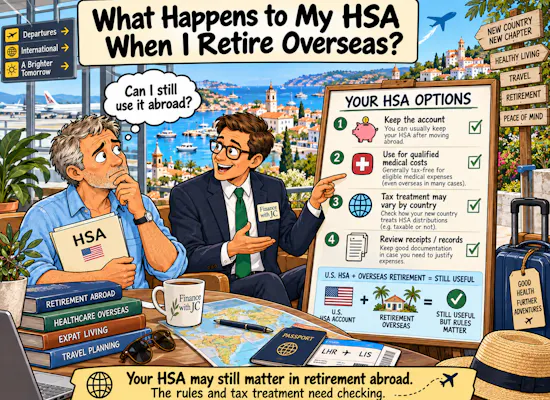
- HSA if relevant
- taxable brokerage
- employer stock plans
- pensions
- Social Security estimate
- cash and emergency reserves
Label each bucket:
- taxable now
- tax-deferred
- tax-free (US definition)
- uncertain overseas treatment
Step 3: Choose your tax strategy with future moves in mind
Ask:
- Are you staying in one country long-term or moving again?
- Which system will tax your withdrawals?
- Do you need FEIE or FTC to support contribution and conversion strategies?
- Does your host country treat Roth favourably?
This is the difference between a plan that survives relocation and a plan that breaks.
Step 4: Build a distribution plan before you retire
Distribution planning includes:
- what you will spend first (cash, taxable, retirement accounts)
- how you will manage RMDs
- whether Roth conversions make sense during low-tax years
- how you will keep liquidity accessible outside the US banking system if needed
If you wait until retirement to design withdrawals, you usually overpay in tax or create avoidable stress.
Step 5: Add the execution layer
The execution layer is what most people skip:
- beneficiaries and contingent beneficiaries
- power of attorney and incapacity planning
- secure document storage
- a “what happens if I die” one-page instruction sheet
- a 6–12 month liquidity runway in the spending currency
Retirement planning is not just investment planning.
What gets overlooked in real life
- People treat the FEIE as a default without checking retirement contribution consequences
- Roth accounts are assumed to be universally tax-free, which is not always true
- Americans abroad often ignore currency risk until the first bad FX cycle
- Social Security is treated as a certainty without checking overseas payment rules and admin requirements
- RMDs become a compliance and banking logistics problem when you are overseas
- Beneficiary forms are forgotten for a decade and then drive unintended outcomes
- Investment “performance” is celebrated while the withdrawal plan is missing
- People retire with no plan for where cash will physically sit and how bills get paid
- Cross-border estates create delays even when wealth is high
- The best plan includes a repeatable annual process, not a perfect one-time design
How to stress-test what you already have
- Do you know your retirement spending currency and baseline annual number?
- Do you have a 12–24 month spending buffer in or near that currency?
- Do you know which country will tax your retirement withdrawals?
- Have you checked how your host country treats Roth withdrawals and conversions?
- Are your 401(k) and IRA beneficiaries current and aligned with your family plan?
- Do you have a distribution plan that integrates Social Security, tax, and RMD timing?
- Are you relying on FEIE without checking IRA contribution eligibility consequences?
- Have you stress-tested a bad sequence: markets down 25% plus FX down 15%?
- Do you have an execution pack your spouse could use in the first week after death?
- Do you have a plan for banking and transfers if you cannot access US systems quickly?
- Are you comfortable your plan still works if you move countries again?
Common mistakes
- Assuming US retirement planning is the same abroad as it is in the US
- Using FEIE automatically and accidentally reducing IRA contribution options
- Doing Roth conversions without confirming host-country treatment
- Ignoring currency mismatch between assets and spending
- Treating Social Security as plug-and-play without checking overseas payment rules
- Rolling a 401(k) to an IRA without understanding creditor protection and plan feature differences
- Retiring without a withdrawal sequence plan
- Delaying beneficiary updates after marriage, divorce, or children
- Holding a high-risk portfolio without a spending bucket, then being forced to sell during downturns
- Focusing on investment selection while neglecting admin, execution, and documentation
Common objections
“I’ll deal with retirement when I move back to the US.”
Emotional logic
You want to wait until life is stable.
Practical risk
Your best planning windows are often while abroad. Tax brackets, Roth conversion opportunities, and currency alignment decisions are time-sensitive. Waiting can remove options.
Clean next step
Build a portable plan: account inventory, currency plan, and beneficiary updates. You can refine later.
“My Roth is tax-free, so it’s always the best account.”
Emotional logic
Roth feels like the obvious winner.
Practical risk
Overseas tax treatment can differ. Some countries do not recognise Roth benefits in the same way. That can turn a great US strategy into a mixed result.
Clean next step
Confirm host-country treatment of Roth contributions, conversions, and withdrawals before building a strategy around it.
“I use the FEIE, so I’m basically done with US tax planning.”
Emotional logic
You want simplicity.
Practical risk
FEIE can create downstream effects for IRA contributions and long-term strategy. It also does not remove reporting responsibilities.
Clean next step
Check how FEIE interacts with your retirement funding plan and whether FTC would support better long-term outcomes.
“I’m earning well abroad. I don’t need to think about Social Security.”
Emotional logic
Social Security feels small relative to income.
Practical risk
Social Security can be your most stable inflation-linked income layer. Overseas payment rules and admin should be planned, not discovered later.
Clean next step
Get your Social Security estimate and integrate it into your retirement income floor planning.
“I’ll just keep everything in USD. The dollar is safer.”
Emotional logic
USD feels like stability.
Practical risk
Safety is relative to your spending currency. If you spend in EUR, GBP, AED, or another currency, USD-only exposure can create purchasing power volatility.
Clean next step
Build a currency plan: a spending bucket in your spending currency and diversified long-term assets.
“I’m worried about PFICs and reporting, so I avoid investing where I live.”
Emotional logic
You fear making a mistake.
Practical risk
Avoidance can lead to concentrated risk and missed planning opportunities. The goal is compliant investing, not no investing.
Clean next step
Design an investment approach that is compatible with your US status and your country of residence, using appropriate wrappers and reporting discipline.
“This is too complicated. I just want a simple retirement number.”
Emotional logic
You want clarity.
Practical risk
A single number without tax, FX, and distribution planning is false certainty. The plan can still fail in execution.
Clean next step
Start with three numbers: annual spending target, spending currency, and 12-month liquidity buffer. Then build out accounts and withdrawals.
“I’ll sort beneficiaries later. That’s not urgent.”
Emotional logic
It feels like paperwork.
Practical risk
Beneficiary designations are often what actually determines outcomes for retirement accounts. Outdated forms cause delays and unintended recipients.
Clean next step
Update beneficiaries this week and store confirmation in your executor pack.
Decision framework
- Choose retirement location assumptions and spending currency
- Set a baseline spending number and define essential vs discretionary costs
- Inventory accounts and label tax treatment in the US and locally
- Decide FEIE vs FTC strategy with retirement contributions in mind
- Build an investment plan that matches spending currency risk and time horizon
- Build a withdrawal plan that integrates Social Security, tax brackets, and RMDs
- Decide whether Roth conversions are sensible in your current country and timeline
- Update beneficiaries, add contingents, and align with estate plan
- Build an executor pack and a 6–12 month liquidity buffer
- Review annually and at trigger events: relocation, marriage, divorce, new child, new country of tax residence
If you only do 3 things this week
- Create your one-page account inventory and beneficiary audit.
- Define your spending currency and build a 6–12 month cash buffer plan.
- Confirm whether your current tax approach supports IRA contributions and Roth strategy.
Self-diagnostic
Answer yes or no:
- Do you know which country will likely tax your retirement withdrawals?
- Have you checked how your host country treats Roth withdrawals and conversions?
- Are you using FEIE without checking IRA contribution consequences?
- Is your future spending currency different from USD?
- Do you have a 12-month liquidity buffer outside your retirement accounts?
- Do you have a written withdrawal sequence plan?
- Are beneficiary designations older than two years?
- Would your spouse know where your account details and contacts are stored?
- Have you integrated Social Security into your retirement income floor?
- Have you stress-tested bad markets plus bad FX at the same time?
- Are you likely to relocate again in the next five years?
- Do you rely on one account type for everything, for example all traditional pre-tax?
Interpretation
- Green (0–3 yes): you likely have a coherent base. Keep reviewing annually.
- Amber (4–7 yes): meaningful friction risk. Build the withdrawal and currency plan now.
- Red (8+ yes): your plan is vulnerable to tax, FX, or admin failure. Prioritise execution and structure immediately.
FAQ
Quick definitions
- 401(k): employer retirement plan, typically tax-deferred, sometimes with Roth option.
- Traditional IRA: personal tax-deferred retirement account, contributions and deductions are rule-based.
- Roth IRA: after-tax contributions with potential tax-free qualified withdrawals under US rules.
- Roth conversion: moving pre-tax retirement funds into Roth and paying tax in the conversion year.
- RMD: required minimum distribution rules for certain retirement accounts.
- FEIE: foreign earned income exclusion for qualifying US taxpayers abroad.
- FTC: foreign tax credit that offsets US tax with foreign taxes paid.
- Treaty: tax agreement between countries that can affect retirement taxation.
- Withholding: tax withheld at source on distributions.
- Beneficiary designation: form that controls who receives the account on death.
Questions and answers
Can Americans abroad still contribute to an IRA or Roth IRA?
Yes, if you have qualifying compensation under US rules.
Living abroad does not automatically stop IRA contributions. The key is whether you have compensation that counts and whether income limits and deduction rules apply. Using the FEIE can reduce taxable compensation, which can reduce contribution eligibility in some situations. Confirm your filing strategy before assuming you can contribute each year.
Does the FEIE affect IRA contributions?
It can, because it can reduce taxable compensation.
IRA contribution eligibility depends on compensation rules. If you exclude most or all earned income using the FEIE, you may reduce the compensation available to support IRA contributions, depending on your facts. This is a common expat trap. The right approach is to run a plan-based comparison of FEIE versus FTC with retirement goals in mind.
Can I keep my 401(k) when I leave the US?
Usually yes.
Most people keep their 401(k) invested after moving abroad. The bigger questions are fees, investment choice, and how distributions will work later when you are living overseas. Rolling to an IRA can improve control, but it can also change protections and features. Treat it as a strategic decision, not a default.
Should I roll my 401(k) into an IRA while living abroad?
Sometimes, but it depends on fees, investment options, and future planning.
An IRA can offer wider investment choice and simpler consolidation. A 401(k) can have strong institutional pricing and plan-specific features. The best answer depends on your goals, where you live, and your future withdrawal plan. If you may return to the US, state tax considerations can also matter.
Should I do Roth conversions while living abroad?
Only if the tax treatment works in both the US and your current country.
Roth conversions can be powerful if you are in a lower-tax window, but host-country tax treatment can change the outcome materially. You also need to consider how conversions interact with future Social Security taxation and RMD timing. Stage conversions, model worst-case tax treatment, and treat relocation as a key risk.
Will Social Security pay me if I live overseas?
Often yes, but there are rules and exceptions.
US citizens can usually receive Social Security payments abroad in many countries. Noncitizens have additional restrictions and may need to meet exceptions to continue receiving payments outside the US. The SSA provides specific guidance on payments abroad and when payments can stop.
How do I avoid double taxation on US retirement withdrawals?
You plan withholding, treaty position, and local reporting before you withdraw.
Some countries tax US retirement distributions, some give credits, and treaty provisions can shift taxing rights. The practical process is: confirm treaty treatment, determine withholding requirements, then coordinate withdrawals with local tax deadlines. Avoid ad-hoc withdrawals that create avoidable withholding or mismatched credits.
Do I pay US tax on withdrawals if I live in a no-tax country?
Often yes, because US tax rules still apply to US citizens.
Living in a no-tax jurisdiction does not automatically remove US tax on retirement withdrawals. You may still have US taxable income and withholding. The benefit of a no-tax country can be that there is no second layer of local tax, but you still need a proper US withdrawal plan.
How should I think about currency risk in retirement abroad?
Treat it as a cashflow problem, not an investment problem.
You need spending money in your spending currency. A USD portfolio funding EUR spending can produce purchasing power swings. The practical fix is a spending bucket and a currency strategy for near-term withdrawals, while keeping long-term assets diversified.
What is the best order to withdraw from accounts abroad?
It depends on tax brackets, treaty treatment, and your account mix.
A common approach is to use taxable assets for flexibility, manage pre-tax withdrawals to control brackets and RMDs, and preserve Roth for later and legacy. Overseas, you must also consider local tax treatment and withholding. The right order is the one that reduces lifetime tax and protects against sequence and FX risk.
Do beneficiary designations matter if I have a will?
Yes, often more than the will for retirement accounts.
401(k)s and IRAs generally pass by beneficiary designation. If the form is outdated, the wrong person can receive the account, regardless of what the will says. Keep primary and contingent beneficiaries current, especially after marriage, divorce, or children. Store confirmations in an executor pack.
What are the 2026 contribution limits for 401(k) and IRA?
They increased for 2026 under IRS announcements.
For 2026, the IRS announced higher limits, including $24,500 for 401(k) type plans and $7,500 for IRAs, with catch-up contribution rules applying by age.
How do I build a retirement plan if I might move countries again?
Build a portable plan that works under multiple tax regimes.
That means: diversify account types, avoid strategies that only work in one treaty, keep a strong liquidity buffer, and maintain an annual review process. Treat relocation as a planning trigger, not a surprise. The goal is a plan that can be adapted without blowing up the tax and withdrawal strategy.
What is the single most important first step?
Get clarity on spending currency and your account inventory.
Once you know what currency you will spend in and you have a complete list of accounts and beneficiaries, you can design tax, investment, and withdrawal strategy properly. Without that, most retirement plans are guesswork dressed up as confidence.
What happens next
A sensible advice process usually follows five steps:
- Clarify retirement objectives, location assumptions, and spending currency
- Quantify your numbers: spending target, buffers, Social Security, and account inventory
- Build the structure: FEIE vs FTC approach, Roth strategy, withdrawal sequencing, currency plan
- Implementation review: investments, rebalancing, RMD process, banking and withholding set-up
- Ongoing review triggers: relocation, tax residency changes, Social Security claiming, major market moves, and family changes that affect beneficiaries
You may also like
Understanding US retirement accounts for expats: 401(k), IRA and rollover planning
Foreign Earned Income Exclusion (FEIE): US expat tax exemption explained
Holding US shares as a non-US investor: estate tax risks and planning considerations
Best countries for UK expats to retire: tax, pensions and lifestyle considerations
Beneficiary nominations explained: pensions, life insurance and offshore investment wrappers (2026)
Digital assets and passwords in estate planning: protecting online accounts and crypto (2026)
Conclusion
Retirement planning for Americans abroad is not about picking the best ETF.
It is about building a system that survives reality:
- US tax rules that follow you
- host-country treatment that can change by country
- currency risk that affects real spending
- admin execution that your spouse can handle under stress
If you get four things right, you are ahead of most expats:
- a clear spending currency plan
- a clean account inventory with updated beneficiaries
- a tax strategy that supports contributions and future withdrawals
- a repeatable annual review process tied to relocation and life events
Compliance note
This article is for general education only and is not personal financial, legal, or tax advice. US and local tax rules can change and depend on your circumstances, residence, and treaty position. Social Security rules and overseas payment eligibility vary. Take regulated, jurisdiction-specific advice before acting.
References
https://financewithjc.com/blog/understanding-us-retirement-accounts-for-expats
https://financewithjc.com/blog/us-expat-tax-exemption
https://financewithjc.com/blog/hold-us-shares-read-this?category=Financial+guidance
https://www.irs.gov/newsroom/401k-limit-increases-to-24500-for-2026-ira-limit-increases-to-7500
https://www.irs.gov/retirement-plans/plan-participant-employee/retirement-topics-ira-contribution-limits
https://www.ssa.gov/international/payments.html
https://www.ssa.gov/faqs/en/questions/KA-02447.html
https://www.fca.org.uk/consumers/insurance